
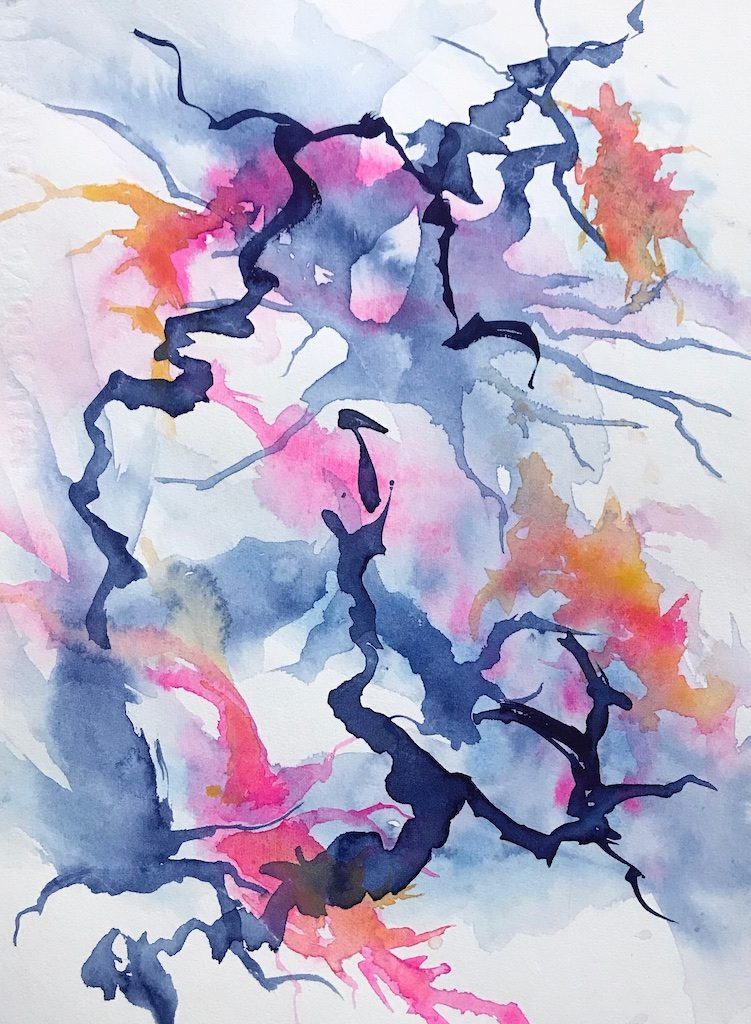
When I sat down to paint, my internal critics went into overdrive. Your art isn’t good enough, they said. It will never be good enough.
I cried. I screamed. I told myself that I sucked. I told Ron I wasn’t sure I wanted to keep painting.
Then, I kept painting.
I zoomed in on the weaknesses in my work: my tendency to make the objects in my paintings too consistent in size, my lack of value variation.
Then, I kept painting.
I took another watercolor class. I tried to paint the same flower three times and never got it right. I cried again—and buried my new paintings at the bottom of a very deep drawer—my Drawer of Shame.
Then, I kept painting.
I worked with an art teacher who introduced me to abstract art and acrylic glazes. I hated some of my work so much that I covered some of my paintings with gesso (primer), then painted something else on top.
And then I hated those paintings even more than I had hated the first set.
You’d take a lot of pressure off yourself if you stop painting, I told myself.
Then, I kept painting.
Yesterday my upstairs neighbor, Sharon, came over to see my work. I cringed and opened the Drawer of Shame.
“Ooh, I love that,” Sharon said.
I braced myself and looked down, expecting to disagree with Sharon’s assessment. It was an abstract watercolor I’d painted several months earlier—and been dissatisfied with.
Three months later, I could see that the work was ok. Some of the paint handling was pretty good. I liked my color choices.
As Sharon dug through the drawer, I saw my work with fresh eyes. Clean, bright colors, better use of white space, interesting textures that weren’t there before.
My work was improving. It’s a slow, hard process, but viewed with a little distance, I can actually see it.
I’m glad I kept painting.